Pen-Y-Fan from Cribyn
Learn to fall in love with the mountain not just the summit

Friday, March 19, 2010

Offa's Dyke - Red Daren


The spectacularly stunning scenery of the secluded Vale of Ewyas was an appropriate introduction to the next few hours that were spent in the Black Mountains. The narrow approach road at the foot of a magnificent example of a glacial valley eventually leading to Llanthony Priory.

A partly ruined former Augustinian priory, it lies seven miles north of Abergavenny on an old road to Hay on Wye. The priory dates back to around the year 1100 and eventually became one of the great medieval buildings in Wales, in a mixture of Norman and Gothic architectural styles.


The weather which was dry and mild, meant that this was the first real walk of Spring. The path to Red Daren starts to the west wing of the Priory and takes you through two lower open fields. Here, the climb starts to become really steep before joining a path at the base of the mountain. Climbing over 1200 feet it took about 35 minutes to eventually reach the Hatterall Ridge, which forms the border between Powys and Gwent in Wales and Herefordshire in England. This ridge then followed the Offa's Dyke Path which is a more sedate ramble at this particular section. On the west side of the ridge is the Vale of Ewyas, and on the east side is the Olchon Valley.


King Offa was one of the great rulers of Anglo-Saxon times and someone who was able to raise a workforce and resources sufficient enough to construct such an earthwork Dyke is a testament to his power. A massive linear earthwork, roughly following some of the current border between England and Wales. In places, it is up to 65 feet (20 m) wide. In the 8th century it formed some kind of 'boundary' between the Anglian kingdom of Mercia and the Welsh kingdom of Powys. It is generally accepted that much of the earthwork can be attributed to Offa, who was King of Mercia from 757 to 796.

A major survey of the Dyke in 1955 confirmed that it ran from the estuary of the River Dee in the north to the River Wye in the south (approximately 150 miles or 240 kms). The dyke is not continuous, being built only in areas where natural barriers did not already exist.

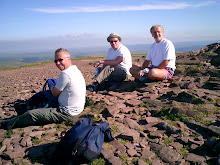
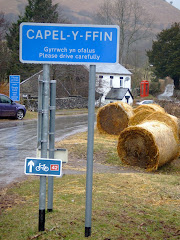
The ridge walk across the top of Red Daren was really easy with excellent views to the low lands of Herefordshire in the east. After a brief coffee break at the trig point, a further few miles stroll across the ridge to a stone sign post that mark's the route to Capel-Y-Ffin, where you can leave this section of Offa's Dyke path. This descent was much steeper than the climb from Llanthony Prior and would be a really hard slog to access the ridge from Vision Farm, which inspired Brice Chatwin's novel 'On the Black Hill'. In really good weather conditions and in stunning surroundings it was really quiet with only a Dutch couple on the ridge and an English couple climbing up the path from Capel-Y-Finn passing in the opposite direction.

The walk was completed with a trek down the deserted road back to Llanthony Prior, where this handsome little follow participated in lunch.

Friday, March 12, 2010

The Appalachian Trail

Perhaps for some the following will summarise the feeling that we all have tackling a strenuous hill/mountain. It is a passage taken from a book written by Bill Bryson when at the age of forty-four he set off to hike through 2,200 miles of remote mountain wilderness filled with bears, moose, bobcats, rattlesnakes, poisonous plants, disease bearing ticks, salamanders and a range of other mammals, flora and fauna.

The Appalachian Trail is the longest continuous footpath in the world, stretching from Georgia to Maine through the Smoky Mountains, Shenandoah National Park, Blue Ridge Mountains of Virginia (...in the shade of the local pines!!) and the Great North Woods of Maine:-

"The hardest part is coming to terms with the constant dispiriting discovery that there is always more hill. The thing about being on a hill, as opposed to standing back from it, is that you can almost never see exactly what's to come. Between the curtain of trees, the ever-receding contour of rising slope before you and your own plodding weariness, you gradually lose track of how far you have come.

Each time you haul yourself up to what you think must surely be the crest, you find that there is in fact more hill beyond, sloping at an angle that kept it from view before, and that beyond that slope there is another, and beyond that another and another, and beyond each of those more still, until it seems impossible that any hill could run on this long.

Eventually you reach a height where you can see the tops of the topmost tress, with nothing but clear sky beyond, and your faltering spirit stirs - nearly there now! - but this is a pitiless deception. The elusive summit continually retreats by whatever distance you press forward, so that each time the canopy parts enough to give a view you are dismayed to see that the topmost trees are as remote, as unattainable, as before. Still you stagger on. What else can you do?

When after ages and ages, you finally reach the tell-tale world of truly high ground, where the chilled air smells of pine sap and the vegetation is gnarled and tough and wind-bent, and push through to the summits open pinnacle, you are, alas, past caring. You soon realise - again in a remote, light-headed, curiously not-there way - that the view is sensational: a boundless vista of wooded mountains, unmarked by human hand, marching off in every direction. This really is heaven, it's splendid, no question."


Extract taken from a 'Walk in the Woods' by Bill Bryson

Tuesday, March 2, 2010

Severn Bore and Slimbridge

The alarm went off (..at 6.00am) for a really early start, mainly because we were in competition with the highest tide of the year on the Severn Estuary, that was due to pass through Minsterworth in deepest Gloucestershire at 8.56am.

A full compliment left the Pearl of the Valleys on schedule at 7.10am, with the glorious sight of pristine white hoar frost gracing the open fields en-route. We arrived at our destination relatively incident free (...Greg was driving!) by 8.15am. There were already hundreds of other spectators in position on the banks of the River Severn in this one spot alone. The potential traffic chaos that could occur after the event looked as though it would be legendary......but there was not one traffic control officer to be seen all morning.


The Severn Estuary has the second largest tidal range in the world. Today was scheduled to be the only 'five star' tide of the year, which occurs when the Moon and Sun are in line with the Earth at their closest distances, directly above the equator. This high spring tide occurs during the equinox in March.


The Severn Bore travels at an average speed of sixteen kilometres an hour and has been known to reach two metres in height. The bore actually went past our viewpoint only a few minutes late which was really considerate.

After departing Minsterworth a wrong exit on the roundabout approaching Gloucester and we completed a 'second lap' of a very congested stretch of the A48 which probably added an extra forty minutes in total onto the second leg of our journey South to the Wildfoul and Wetlands Trust at Slimbridge.

Lunch was taken at the Black Shed Cafe at Patch Bridge in glourious Spring sunshine in the perfect setting on the banks of the Gloucs and Sharpness canal.

Slimbridge, which is 'home' to an astounding array of wildlife including the world's largest collection of swans, geese, and ducks, was the vision of naturalist and artist Sir Peter Scott, who passed away in 1989 and was the first person to be knighted for conservation work.

A particular favourite species of ours was the Eider Duck (see photo below) which is the UK's fastest flying duck. Ironically a true seabird, rarely found away from coasts where its dependence on coastal molluscs for food has brought it into conflict with mussel farmers. Eiders are highly gregarious and usually stay close inshore, riding the swell in a sandy bay or strung out in long lines beyond the breaking waves.


A number of the winter birds were due to leave the wetlands refuge to start the journey north to the Artic Circle where they will spend the Summer, before birds migrating from the Southern Hemisphere are due to arrive at Slimbridge in the next few weeks for rest and recouperation. More Bewick Swans and E White-fronted Geese left last night with a further drop in duck and wader numbers around the reserve observed today. Migration is now well underway. There was also further pre-migration behaviour noted from these species today so of the 226 White-fronts and 200 Bewick Swans that are left more may leave tonight thanks to the ideal weather conditions and the huge tides today that flooded the Dumbles.


Incredibly Steve's magic bag of bird seed appeared to last most of the afternoon and provided some continuous free nosh for the more aggresive inhabitants!!

Monday, February 22, 2010

Neuadd - In her splendid winter clothing!


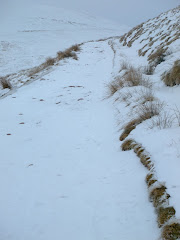
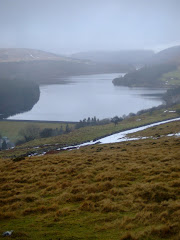
The 4x4's and other off-road vehicles had kindly cleared the one lane access to the Filter House through the Taf Fechan Forest, following further overnight snow in the early hours of Sunday morning.


Icy snow crunched underfoot on a day when crampons would have been the sensible choice of footwear.


A wind chill factor of -5 degrees made it even too cold for any sheep to be seen on the mountainside.


There was one other brave soul heading for Fan-Y-Big, which from the Windy Gap, was shrouded in extremely low, dense cloud.


She does wear this particular season extremely well!!

Friday, February 12, 2010

Garn Ddu - The Wrong Way

The sight of snow flakes gently falling outside the kitchen window at 8.00am, when you are preparing a warm flask of tea for the day ahead, is not the most encouraging start to a winter walk but thankfully the brief flurry didn't last very long. In fact it was very mild when we left the Cefn Community Centre an hour later.

A pleasant walk along the Taff Trail to the Glais Bridge at Pontsarn completed the first leg of the walk and this would be the only time that we would encounter any other person until meeting Dai Harrison outside Cefn Rugby Club at the end of the walk - more of that later.

Steve's previous attempt to find the right path along the river bank had led him to an abrupt end where the water flowed underground and he came to a cul-de-sac in the rocks. On this occassion we climbed the steep bank to the right of the bridge that brought us out into the open fields to the west of the unmistakable Spanish style haccienda - Hy Brassil.


We were a little dissappointed that this series of fields eventually led us to the access road to Llwyn Cilsanws farm, adjacent to Vaynor Quarries. Our compass reading indicated that we needed to continue in a North Westerly direction alongside the Nant-Y-Glais brook.

Arriving at the edge of the fence line that denotes the last of a series of sheep pens we gazed into the distance for the distinctive path that was prominently marked on the O/S map. To our right we were able to see what looked like a significant path leading towards north, but we both felt that this would probably take us in the wrong direction! To our west we were also able to see in the distance what looked like a path adjacent to a fence and this looked the more obvious alternative.

W R O N G! Sometimes we shouldn't rely on our instincts and just trust the map and compass.

When we arrived at the path we discovered what looked like an old drovers route but we soon established that we had also gone a mile in the wrong direction when Steve spotted a trig column to our west. Embarrassingly, Cilsanws Common trig point was nearly two kilometres too far South West from the Roman road that we had originally intended to take.


Even the sight of a majestic Red Kite and the magnificent views down to Llwyn On Reservoir failed to compensate for the disappointment of our wrong turn. Spotting Garn Ddu to our North we treked across the open moorland for a mile to reach the original road that we had intended to use before a relatively short walk to the forestry above Fedw to the north of Llwyn On village.


Leaving the forestry we crossed the main A470 road to join the nature trail around the Southern end of the reservoir before ending the hike along the Cefn Penmaillard path back to Cefn Coed. This is where we bumped into Dai Harrison who was on his way to 'Lunch with a Lion' (Scott Hastings) 24=hours before the Wales/Scotland international the following day. Warren Gatland's men also seemed to be travelling in the wrong direction for 70 minutes until they seemed to find their 'mojo' in the final stages of their quest!!

A little bit like us really.

Friday, December 4, 2009

First Snow of Winter

After continuous rain for almost a month, a window of opportunity and the first dusting of snow on the Beacons tempted a solo visit to Pen-Y-Fan on Friday 4th December 2009.

Leaving the car park south of the Storey Arms visibility was good enough to see Corn Ddu rising in the distance as the steady climb to Bwlch Duwyrit began.


Passing a few walkers on thier way down, the hillside was relatively quiet for a late morning on a Friday in near perfect winter conditions.

The only other walkers encountered on the elbow of Corn Ddu was a small party of sixth formers who were debating whether or not to make the final push for the icy summit.


With poor visibility and a strong cross wind blasting across the top of Pen-Y-Fan, a quick bite on a banana and the trek back down the mountain began.


This blew away the cobwebs of the month since our last walk in October.

Friday, September 11, 2009

TRIG Pt 642

With a relatively low turn out (half a dozen of us) and a distinct lack of vehicles, it was public transport to the Storey Arms before climbing the Y Gryn route to the elbow of Corn Ddu.

With Mark Crimmings in charge of navigation we headed south-east down Craig Gwaun Taf in relatively good conditions until we arrived at trig point 642 high above the Upper Neuadd Reservoir - and that's when the problems started!

The cloud dropped very quickly and we couldn't see anything, including the outline of the right path to take.

Making our way down Bwlch Gwyn the extremely boggy conditions in the open ground forced us to the edge of the Taf Fechan Forest and after some dificult scrambling through waist high grass at one point we eventually emerged in open ground above Pontsticill Reservoir as a relieved Steve remarked on seeing the Boat House "We've had a result!".

Rather than head for the B road to take us to our destination, Mark decided to seek out the wooden bridge on the far edge of the forest to complete our walk to Pontsticill and a well earned meal in the Butchers.