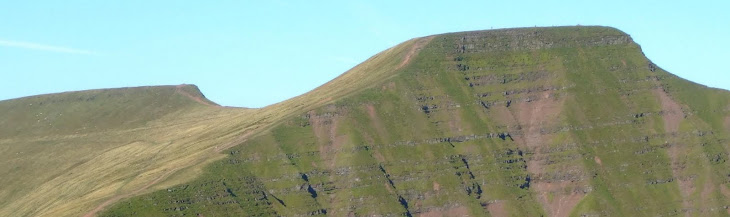
Pen-Y-Fan from Cribyn
Learn to fall in love with the mountain not just the summit

Thursday, March 10, 2011

Walking the Amazon


A date for your diary - Friday, 24th June 2011 - another opportunity to spend an evening at the theatre, this time in the company of British explorer Ed Stafford.


When he set out to walk the entire length of the Amazon river in April 2008, everyone said it couldn’t be done. He was told he would probably die, that it was too far, that he would be ill or that the dense forest, biting insects, snakes, bogs, jaguars and fearful tribes would be too much. But he went anyway. Two and half years later, (18 months longer than he thought it would take), Ed finally emerged from his epic trek reaching the Atlantic Ocean on 9th August 2010 to become the first known person to walk the 4,000 miles length of the Amazon river from source to sea.

In ‘Walking the Amazon’, Ed recounts his epic 860-day journey with images and footage from his expedition. He uses the experience to inspire and motivate audiences to achieve their own personal goals and shows that is it possible to succeed even when faced with seemingly insurmountable hardship.

'My aim is to inspire others and to make people feel that they have a connection to the Amazon, its wonders and its problems. I also hope to motivate others to believe they can achieve their dreams, by listening to my story of what it takes to strive to become the first man ever to walk the entire length of the Amazon River.'

His laid back, humorous style educates and enthralls. The presentation will be a mixture of narrative and pictorial anecdotes and documentary filmed by Ed himself in the jungle. He will take the audience with him back to the jungle via his presentation and help to inspire them to see life ahead as an adventure ready to begin.


'A stupendous achievement, right up there with Hillary’s ascent of Everest and the conquerors of the poles.' Daily Mail

'Truly extraordinary...in the top league of expeditions past and present.' Sir Ranulph Fiennes

Tuesday, March 8, 2011

Beacons Way Improvements

Almost 100 miles (161km) of footpaths in the Brecon Beacons have recently experienced major improvement. The extremely popular Beacons Way route across Powys, Carmarthenshire and Monmouthshire has been upgraded thanks to current wardens and volunteers.

The path has been eroded by heavy rainfall, with bridges and walkways near area's of waterfalls also being improved. Funding of £92,000 for the project came from the Countryside Council for Wales and the Welsh Assembly Government.

The improvements were made to three sections of the Beacons Way, which traverses nearly 100 miles across the national park from Skirrid Mountain, near Abergavenny, to Bethlehem in Carmarthenshire.

The first section of repairs started at the foot of Craig y Fan Ddu in the central Beacons. A second section - the path from Llyn y Fan Fawr to Fan Brycheiniog - was also upgraded to minimise erosion and improve the experience for walkers. While a third section of the footpath in Carmarthenshire received a new non-slip walkway, along with way marking and sign posting improvements.

Richard Ball of the national park authority said: "The three footpath sections that we've improved along the Beacons Way are strategically very important and will have a significant impact on the walkers who use this route regularly - particularly the Craig y Fan Ddu section of the Beacons Way walk which stretches from Llangynidr to the Storey Arms. This steep and popular section of the route was identified as being in poor condition and in desperate need of repair by walkers and national park staff who survey the route annually."

Saturday, March 5, 2011

Whiteford Sands


A tentative plan was initially hatched on Friday evening, although the decision on the actual destination was not made until the morning.

We arrived in the village of Cheriton, a mile from Broughton Bay on the north-west of the Gower Peninsula at 12:30, parking opposite the local community hall.

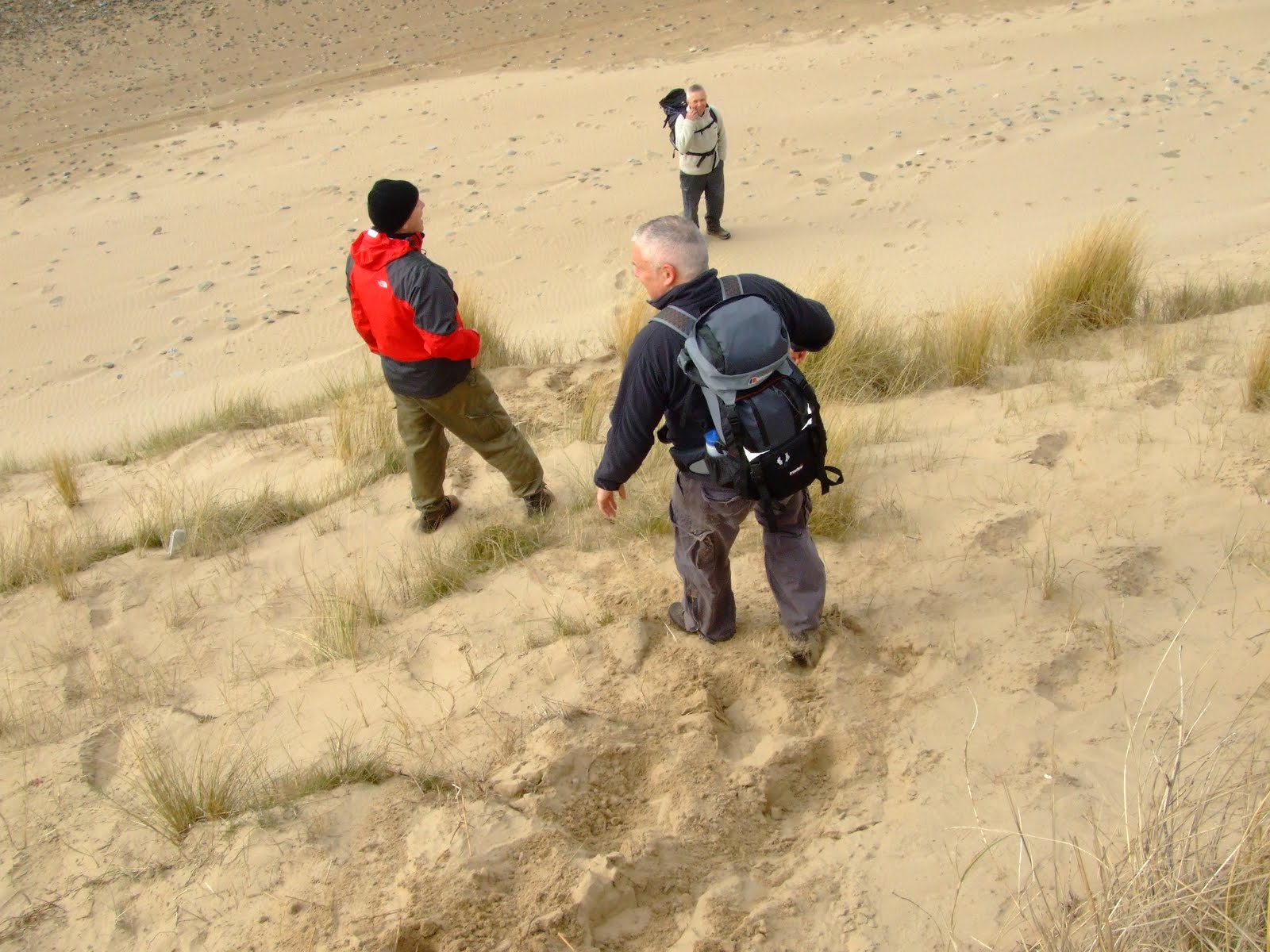
Before we reached Whiteford Burrows we needed to walk across the top of the man-made dyke that separates the Llanrhidian salt-marshes from the freshwater river. The undulating sand dunes were negotiated with Steve complaining that it would have been easier to get to Dunkirk! Whiteford Burrows is owned by the National Trust and is classed as a national nature reserve.


We were able to leave the dunes descending down a 20 foot wall of sand, before reaching the two mile expanse of the most northerly beach on the Gower, sitting on the edge of the Loughor estuary.


The beach has no direct access by car and it's relative inaccessibility compared to many other beaches on the peninsular makes it very quiet.
The main target for the walk was Whiteford Lighhouse. Built in 1865, by the Llanelli Harbour and Burry Navigation Commissioners to mark the shoals of Whiteford Point, it is the only wave-swept cast-iron tower of this size in Britain. The tower is 44 feet high and stands just above low-water level. The base is about 24 feet in diameter and rises gracefully to a diameter of 11 feet six inches at lantern level. A pitched stone apron has been laid around the base of the Lighthouse.

The Lighthouse is listed by Cadw as Grade II*, as a rare survivor of a wave-swept cast-iron lighthouse in British coastal waters, and an important work of cast-iron architecture and nineteenth century lighthouse design and construction. It is also a Scheduled Ancient Monument.


Operation of the lighthouse was discontinued in 1920, when responsibility for the light was transferred to Trinity House, who decided to establish a new beacon at Burry Holms. However, after pleas from local yachtsmen, the light was re-lit in the 1980s. This gave an additional point of reference when navigating the waters between the Gower Peninsula and Burry Port. On dark nights, boat crews often found themselves on top of Whiteford Point before realizing the fact. The new light was fully automatic and switched on when daylight faded to a pre-determined level.

After a failure of the solar unit, the light was removed and not replaced. However, the Lighthouse still has navigational value in daylight. The Lighthouse is now owned by Carmarthenshire County Council.

With the tide extremely low we were able to walk to the base of the lighthouse and enjoy a cup of tea, some cake and biscuits.


Returning across the huge expanse of open beach we only saw about half a dozen people all day.

The excellent meal in the Greyhound Inn at Oldwalls was throughly enjoyable after a day spent in the exhilarating sea air.

Photographs taken on this walk can be viewed here. Select 'slide-show' for automated viewing.

Friday, March 4, 2011

Referendum

Wales has said a resounding 'YES' in the referendum on direct law-making powers for the Assembly.

When the last result was declared, all 22 counties minus one - Monmouthshire - backed change. Turnout is provisionally put at 35%.

The final result saw 517,132 vote Yes, and 297,380 say No - a 63.5% winning margin.

The vote will now give the Assembly direct law-making power in 20 devolved areas, such as health and education. First Minister Carwyn Jones told celebrating supporters in the Senedd, the Assembly building in Cardiff Bay: "Today an old nation came of age". Deputy First Minister and Plaid Cymru leader Ieuan Wyn Jones said it marked "the beginning of a new era of Welsh devolution - the decade to deliver for Wales".

Thursday, March 3, 2011

River Daze


Although the clear blue sky gave the impression that spring is on the way the temperature was only nudging 1 degree Celsius. This particular walk is a regular of Butterballs and the last time I accompanied him on New Years Day 2010, the battery on the camera was flat (this had absolutely nothing to do with the celebrations the previous night!).


Perhaps it was a little optimistic to expect to catch a glimpse of the heron's that frequent this section of the river, and although there were lots of dippers, blue tits, coal tits and ducks the elusive heron's failed to put in an appearance.


The start of the path passes in the front of 'Bridge House' at Pont-Y-Cefn, you are then only ever a few feet away from the river itself on both sides of the bank. Deciding to ignore the signs and risk the wrath of anyone felling trees, although it must have been their day off because there was no sign of any arboricultural activity whatsoever, the route takes you under a bridge which is part of the extremely busy Heads of the Valley road (A465) and runs almost parallel to the Taff Trail, only at a much lower level.


I assume that this must be the feeder to the lake that requires the tree maintenance. This is one of 44 regional projects sponsored by the Valleys Regional Park and funded through ERDF, to restore the historically important Cyfarthfa Lake Feeder and enhancement of the adjacent equally important old tramway to provide 1 kilometre of new pedestrian access between Cyfarthfa Park and Taf Fechan Nature Reserve. The feeder was used as a leat to top up the lake in Cyfarthfa Park to power the Crawshay iron works between 1786 and 1910.


There was a large group of elderly walkers on the entry to Rees's Wood also enjoying the route today. After crossing Pontsarn bridge the path takes you underneath the seven arch span of the Pontsarn Viaduct (which was walked across in November).


Crossing a footbridge at the furthest part of the walk you return south past the famous Blue Pool, a popular spot for swimmers during the summer months. Passing below Trefechan you once again enter the woodland section at Coed Llaindir which is part of the Cwm Taf Fechan Nature Reserve, eventually crossing a bridge over the weir before returning to the start.


There are extremely dramatic sections of the river where it has cut through the rocky strata to create narrow fast flowing waterfalls, while in significant contrast other sections are wider, flat and calmer.


The walk was 6 miles and took about 2 hours.

Thursday, February 24, 2011

Pen-Y-Fan Debut

'I've never climbed Pen-Y-Fan; I'd like to do it during the half-term holidays if we could?' was the recent request made by Wandering's Son-in-Law.

The only suitable day according to the weather forecast was Thursday, but the inevitable school holidays would mean loads of other families with the same idea.

The beauty of climbing Pen-Y-Fan on that first occasion is always the stunning views that inevitably entice you back for a second peek, but the low lying cloud today was an ominous factor as we approached the Storey Arms on the A470.


Despite the school holidays the car park to the south of the Storey Arms was surprisingly only half full as we crossed the bridge over the Taff Fawr and joined the Beacons Way. The normal view of Corn Du on the ascent was already non-existent! We entered the clag after 2 kilometres of the steady climb up to Bwlch Duwyrit, which we reached in 40 minutes (Jonathon trains regularly at a kick boxing gym so is very fit!).

There was a short queue for the scramble over the rocky outcrop at Corn Du before reaching the summit of Pen-Y-Fan (886 metres) after 45 minutes walking (humble apologies to Lord Twynyrodyn and the National Trust but there really was nothing to see on the mountain today!).

We left the howling wind and poor visibility on the summit cairn to shelter on the South East face of Craig Cwm Sere, for a warm cup of tea and a ham sandwich.


With the return descent into the inevitable prevailing wind it was decided to leave the mountain via Craig Cwm Llwch and Y Gyrn back to the Storey Arms to complete the circular route.

Wednesday, February 23, 2011

Notes from a Small Island

Written by American author Bill Bryson (first published in 1995), this is a humorous (laugh out loud) travel book about what he liked about the country so much.

There is a brilliant passage on male toilet humour that is actually hysterical and a true but not so complimentary encounter in North Wales, but the following excerpt sums up the reason why so many people actually enjoy trekking in Britain.

I remember when I first came to Britain wandering into a book store and being surprised to find a whole section dedicated to 'Walking Guides'. This struck me as faintly bizarre and comical - where I came from people did not as a rule require written instructions to achieve locomotion - but then gradually I learned that there are, in fact, two kinds of walking in Britain, namely the everyday kind that gets you to the pub, and all being well back home again, and the more earnest type that involves stout boots, Ordinance Survey maps in plastic pouches, rucksacks with sandwiches and flasks of tea, and, in this terminal phase, the wearing of khaki shorts in appropriate weather.

For years, I’ve watched these walker types toiling off up cloud-hidden hills in wet and savage weather and presumed they were genuinely insane. And then my old friend John Price, who had grown up in Liverpool and spent his youth doing foolish things on sheer-faced crags in the Lakes, encouraged me to join him and a couple of his friends for an amble – that was the word he used – up Haystacks one weekend. I think it was the combination of those two untaxing-sounding words, ‘amble’ and ‘Haystacks’ that lulled me from my natural caution.

‘Are you sure that it’s not too hard?’ I asked.

‘Nah, just an amble,’ John insisted.

Well, of course it was anything but an amble. We clambered for hours up vast, perpendicular slopes, over clattering scree and lumpy tussocks, round towering citadels of rock, and emerged at length into a cold, bleak, lofty nether world so remote and forbidding that even the sheep were startled to see us. Beyond it lay even greater and remoter summits that had been quite invisible from the ribbon of black highway thousands of feet below. John and his chums toyed with my will to live in the cruellest possible way; seeing me falling behind, they would lounge around on boulders, smoking and chatting and resting, but the instant I caught up with them with a view to falling at their feet, they would bound up refreshed and, with a few encouraging words, set off anew with large, manly strides, so that I had to stumble after and never got a rest.

I gasped and ached and sputtered, and realized that I had never done anything remotely this unnatural before and vowed never to attempt such folly again.

And then, just as I was about to lie down and call for a stretcher, we crested a final rise and found ourselves abruptly, magically, on top of the earth, on a platform in the sky, amid an ocean of swelling summits. I had never seen anything half so beautiful before. 'Fcuk me' I said, in a moment of special eloquence and realized that I was hooked. Ever since then I had come back whenever they would have me, and never complained and even started tucking my trousers in my socks. I couldn't wait for the morrow.